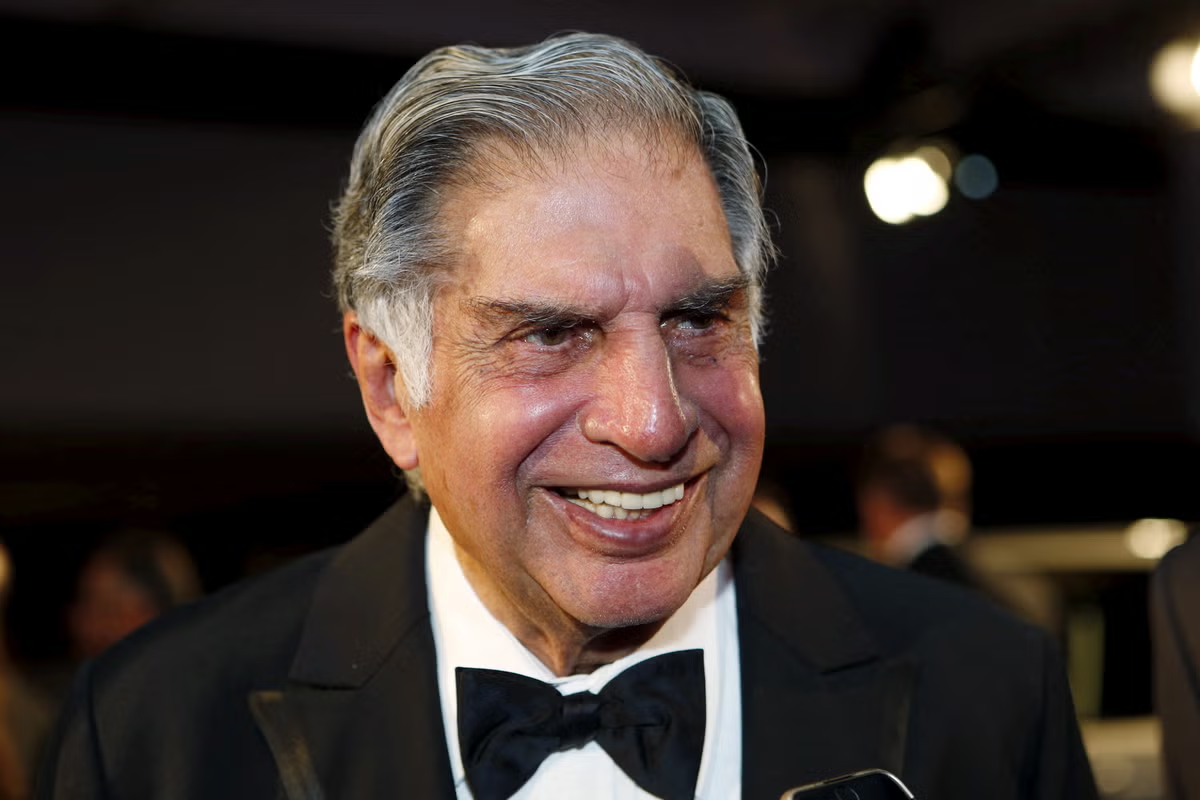
Ratan Tata was one of India’s most recognized business leaders and the former chairman of Tata Sons. He led the Tata Group from 1991 to 2012 and returned as interim chairman in 2016–17. Under his leadership, the Tata Group expanded internationally through major acquisitions and entered new industries and markets. (tata.com)
Born on December 28, 1937, in Bombay, now Mumbai, Ratan Naval Tata studied architecture and structural engineering at Cornell University. He later completed the Advanced Management Program at Harvard Business School. (tatatrusts.org)
Ratan Tata died on October 9, 2024, at the age of 86. His career remains closely connected with the globalization of the Tata Group, major international acquisitions, innovation, and philanthropy. (tata.com)
Ratan Tata Quick Facts
| Category | Details |
|---|---|
| Full Name | Ratan Naval Tata |
| Date of Birth | December 28, 1937 |
| Birthplace | Bombay, India |
| Died | October 9, 2024 |
| Age at Death | 86 years |
| Nationality | Indian |
| Education | Cornell University; Harvard Business School |
| Famous For | Former Chairman of Tata Sons |
| Tata Group Chairman | 1991–2012 |
| Interim Chairman | 2016–2017 |
| Major Companies | Tata Motors, Tata Steel, TCS, Jaguar Land Rover |
| Marital Status | Never married |
| Awards | Padma Bhushan, Padma Vibhushan, GBE |
| Known For | Global expansion and philanthropy |
Ratan Tata’s official Tata Group biography records his birth, education, Tata career and major milestones, while Tata Trusts confirms his death on October 9, 2024. (tata.com)
Who Was Ratan Tata?
Ratan Tata was an Indian industrialist who served as chairman of Tata Sons, the principal holding company of the Tata Group.
He took over as chairman from J.R.D. Tata on March 25, 1991, at a time when India’s economy was beginning a major period of liberalization. He subsequently pushed the group toward greater integration and international expansion. (tata.com)
During his leadership, Tata companies expanded beyond India through acquisitions including Tetley, Corus and Jaguar Land Rover.
His leadership therefore became an important chapter in the transformation of Tata from a primarily India-focused business group into a more global conglomerate.
Ratan Tata Early Life
Ratan Naval Tata was born on December 28, 1937, in Bombay.
His parents were Naval Tata and Soonoo Tata. After his parents separated, Ratan Tata and his younger brother Jimmy were raised largely by their grandmother, Lady Navajbai Tata. (tata.com)
He attended Campion School and later Cathedral and John Connon School in Bombay.
According to the Tata Group’s biography, he was interested in music, played the piano and was also involved in cricket during his younger years. (tata.com)
Ratan Tata Education
Ratan Tata moved to the United States in 1955 to study at Cornell University.
He initially studied engineering but later switched to architecture. He eventually earned a bachelor’s degree in architecture from Cornell in 1962. (tata.com)
He later completed the Advanced Management Program at Harvard Business School in 1975.
His education combined technical training, architecture and advanced management education, which became useful during his later career in industrial and corporate leadership.
How Did Ratan Tata Start His Career?
Ratan Tata joined Tata Industries in 1962.
Rather than immediately entering a senior office position, he received practical experience inside Tata companies. He spent time training at Tata Engineering and Locomotive Company, now Tata Motors, and later worked at Tata Iron and Steel Company, now Tata Steel, in Jamshedpur. (tata.com)
This early experience exposed him to manufacturing and industrial operations.
In 1971, he became director-in-charge of National Radio and Electronics, commonly known as Nelco.
He joined the board of Tata Sons in 1974 and became chairman of Tata Industries in 1981. (tata.com)
Ratan Tata as Chairman of Tata Group
Ratan Tata became chairman of Tata Sons on March 25, 1991.
His appointment came during a major period of economic change in India. The country’s economic liberalization created new opportunities for Indian companies to compete in increasingly open markets.
Tata’s strategy focused on making the group more cohesive while encouraging companies within the group to become more competitive.
The Tata Group describes this period as one in which Ratan Tata introduced fresh thinking, encouraged innovation and increased the group’s international presence. (tata.com)
Major Tata Acquisitions Under Ratan Tata
One of the defining features of Ratan Tata’s career was Tata’s international expansion.
Tetley
In 2000, Tata Tea acquired Tetley, a major British tea company.
The acquisition gave Tata a stronger international presence in the global tea market.
Corus
In 2007, Tata Steel acquired Corus, a major European steel producer.
The transaction significantly expanded Tata Steel’s international operations.
Jaguar Land Rover
In 2008, Tata Motors acquired Jaguar Land Rover from Ford.
The acquisition brought two internationally recognized automotive brands into the Tata Group.
Why Were These Acquisitions Important?
These deals helped establish Tata as a multinational business group with operations and brands across multiple countries.
They also changed the perception of Tata from an Indian conglomerate with international interests into a group with significant global businesses.
Ratan Tata and Tata Nano
Ratan Tata was closely associated with the Tata Nano project.
The Nano was introduced in 2008 as a small, affordable car designed for the Indian market.
The project reflected Tata’s interest in creating products for a large section of India’s population and became one of the most discussed automobile launches in the country.
The Tata Group’s official history identifies the Nano as one of the major projects developed under Ratan Tata’s leadership. (tata.com)
Ratan Tata and Tata Trusts
Philanthropy was an important part of Ratan Tata’s public and professional legacy.
He served as chairman of the Tata Trusts and supported initiatives involving education, healthcare, research and community development.
Tata Trusts’ history states that Ratan Tata’s work continued the group’s long-standing philanthropic tradition. (tatatrusts.org)
The Tata Trusts also expanded cancer-care initiatives during the later years of his leadership.
In 2022, Ratan Tata established the Ratan Tata Endowment Foundation. (tata.com)
Ratan Tata Net Worth
Ratan Tata’s personal wealth is frequently misunderstood because of the ownership structure surrounding Tata Sons and the Tata Trusts.
Unlike many billionaire founders, Ratan Tata did not personally own the Tata Group.
A significant portion of Tata Sons’ ownership is held by philanthropic Tata trusts. Therefore, estimates of his personal net worth should not be confused with the total value of Tata Group companies.
For this reason, there is no reliable official figure for Ratan Tata’s personal net worth at the time of his death.
Various websites have published estimates, but these figures often differ considerably and may not accurately represent his personal assets.
For a biography, it is more accurate to distinguish Ratan Tata’s personal wealth from the much larger economic value of the companies associated with the Tata Group.
Ratan Tata Family
Ratan Tata was the son of Naval Tata and Soonoo Tata.
He had a younger brother, Jimmy Tata, and a half-brother, Noel Tata.
Ratan Tata never married and did not have biological children.
He was raised for much of his childhood by his grandmother, Lady Navajbai Tata. (tata.com)
His personal life was generally private, and he rarely discussed it extensively in public.
Ratan Tata Awards and Honors
Ratan Tata received several major national and international honors.
Padma Bhushan
The Government of India awarded Ratan Tata the Padma Bhushan in 2000.
Padma Vibhushan
He received the Padma Vibhushan in 2008, India’s second-highest civilian honor. (tata.com)
Knight Grand Cross of the Order of the British Empire
In 2014, he was awarded the honorary Knight Grand Cross of the Order of the British Empire.
He also received honorary degrees and recognition from universities and institutions in India and abroad.
Ratan Tata and Startup Investments
After stepping down as chairman of Tata Sons in 2012, Ratan Tata became an active supporter of India’s emerging startup ecosystem.
Beginning in 2014, he invested personally in a number of Indian startups.
His investments included companies from areas such as technology, consumer services, finance and e-commerce.
This helped make him a recognizable individual investor within India’s startup ecosystem.
Ratan Tata’s Death
Ratan Tata died on October 9, 2024, at the age of 86.
Tata Trusts officially announced his death, while Tata Group Chairman N. Chandrasekaran described his contribution to the group and society in a statement issued after his passing. (tatatrusts.org)
His death received widespread attention in India and internationally.
He remains associated with Tata’s global expansion, philanthropy, automobiles, technology and several major business acquisitions.
Ratan Tata Career Timeline
| Year | Major Event |
|---|---|
| 1937 | Born in Bombay |
| 1955 | Went to Cornell University |
| 1962 | Earned architecture degree and joined Tata Industries |
| 1963 | Began training at Tata Steel |
| 1971 | Became director-in-charge of Nelco |
| 1974 | Joined Tata Sons board |
| 1975 | Completed Harvard Business School Advanced Management Program |
| 1981 | Became Chairman of Tata Industries |
| 1991 | Became Chairman of Tata Sons |
| 2000 | Tata acquired Tetley |
| 2007 | Tata Steel acquired Corus |
| 2008 | Tata Motors acquired Jaguar Land Rover |
| 2008 | Tata Nano launched |
| 2012 | Stepped down as Tata Sons chairman |
| 2014 | Began investing in startups; received honorary GBE |
| 2015 | Inducted into Automotive Hall of Fame |
| 2016–17 | Served as interim Tata Sons chairman |
| 2022 | Established Ratan Tata Endowment Foundation |
| 2024 | Died at age 86 |
(tata.com)
Why Is Ratan Tata Famous?
Ratan Tata is famous for several major contributions to Indian business:
- Leading Tata Sons from 1991 to 2012
- Expanding Tata companies internationally
- Acquiring Tetley
- Acquiring Corus
- Acquiring Jaguar Land Rover
- Supporting the Tata Nano project
- Expanding philanthropic initiatives
- Investing in Indian startups
- Supporting education, healthcare and research
- Receiving India’s Padma Bhushan and Padma Vibhushan
What Made Ratan Tata’s Career Different?
Ratan Tata’s career combined traditional industrial businesses with international expansion and new technology-focused opportunities.
He worked inside Tata companies before becoming chairman rather than starting his career directly at the top.
His tenure also coincided with India’s economic liberalization, giving the Tata Group an opportunity to expand beyond its traditional domestic markets.
The result was a Tata Group with a much larger international presence and a portfolio spanning automobiles, steel, information technology, consumer products, hospitality and other industries.
7 Lessons From Ratan Tata’s Career
1. Start With Practical Experience
Ratan Tata worked at Tata’s industrial operations before becoming chairman.
2. Think Globally
His leadership included major international acquisitions such as Tetley, Corus and Jaguar Land Rover.
3. Take Calculated Risks
Several major Tata investments required significant capital and long-term planning.
4. Build for the Long Term
Many Tata businesses were developed with a long-term ownership approach rather than short-term gains.
5. Innovation Matters
The Tata Nano demonstrated an attempt to develop a completely different type of affordable automobile for the Indian market.
6. Give Back to Society
Philanthropy remained closely connected with the Tata Group and Ratan Tata’s work.
7. Protect Your Reputation
Ratan Tata’s public image was strongly connected with privacy, professionalism and the Tata Group’s broader values.
Interesting Facts About Ratan Tata
- Ratan Tata was born in Bombay in 1937.
- He studied architecture at Cornell University.
- He completed an advanced management program at Harvard Business School.
- He joined Tata Industries in 1962.
- He became Tata Sons chairman in 1991.
- He helped drive Tata’s international expansion.
- Tata Motors acquired Jaguar Land Rover during his chairmanship.
- Tata launched the Nano in 2008.
- He was a major supporter of philanthropy.
- He invested in Indian startups after leaving the chairmanship.
- He never married.
- He died on October 9, 2024, aged 86.
Conclusion
Ratan Tata’s biography is the story of an industrialist who helped transform the Tata Group into a more globally connected business organization.
From his early work on the factory floor to becoming chairman of Tata Sons, his career covered manufacturing, automobiles, steel, technology, consumer products and international business.
His leadership included major acquisitions such as Tetley, Corus and Jaguar Land Rover, while projects such as the Tata Nano reflected his interest in innovation and the Indian consumer market. (tata.com)
Ratan Tata died in 2024 at the age of 86, but his influence continues through Tata Group companies, Tata Trusts, philanthropic initiatives and the institutions supported during his lifetime. (tata.com)
FAQs About Ratan Tata
Who was Ratan Tata?
Ratan Tata was an Indian industrialist and former chairman of Tata Sons. He led the Tata Group from 1991 to 2012 and briefly returned as interim chairman in 2016–17.
When was Ratan Tata born?
Ratan Tata was born on December 28, 1937, in Bombay, now Mumbai, India. (tata.com)
When did Ratan Tata die?
Ratan Tata died on October 9, 2024, at the age of 86. (tatatrusts.org)
What was Ratan Tata’s education?
He studied at Cornell University and earned a bachelor’s degree in architecture. He later completed the Advanced Management Program at Harvard Business School. (tata.com)
When did Ratan Tata become chairman of Tata Group?
Ratan Tata became chairman of Tata Sons on March 25, 1991, succeeding J.R.D. Tata. (tata.com)
What companies did Ratan Tata acquire?
Major international acquisitions during his leadership included Tetley, Corus and Jaguar Land Rover. These transactions expanded Tata’s international business presence.
Did Ratan Tata own Tata Group?
Ratan Tata did not personally own the Tata Group. Tata Sons is the principal holding company of the group, and a large share of Tata Sons is held by Tata philanthropic trusts.
What was Ratan Tata’s net worth?
There is no reliably verified official figure for Ratan Tata’s personal net worth at the time of his death. Online estimates vary, and they should not be confused with the value of Tata Group companies or Tata Sons.
Was Ratan Tata married?
No. Ratan Tata never married and did not have children.
What is Ratan Tata famous for?
He is primarily known for leading Tata Sons, expanding the Tata Group internationally, overseeing major acquisitions and supporting philanthropy, innovation and Indian entrepreneurship.
What awards did Ratan Tata receive?
Among his major honors were the Padma Bhushan in 2000 and Padma Vibhushan in 2008. He also received several international honors and honorary degrees. (tata.com)