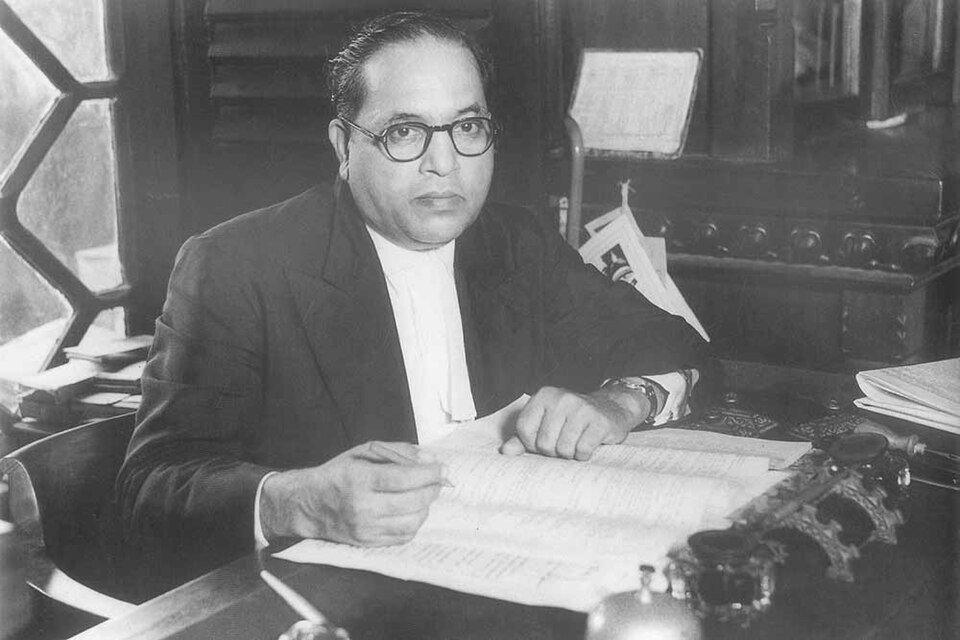
Quick Info → Born: 14 April 1891, Mhow | Died: 6 December 1956 | Title: Babasaheb | Bharat Ratna: 1990
| Bio/Wiki | |
|---|---|
| Full Name | Bhimrao Ramji Ambedkar |
| Popular Name | Babasaheb Ambedkar, B.R. Ambedkar |
| Titles | Father of Indian Constitution, Architect of Indian Constitution |
| Profession | Jurist, Economist, Politician, Social Reformer, Scholar, Author |
| Known For | Drafting Indian Constitution; Dalit rights movement; Buddhist conversion |
| Physical Stats | |
| Height | approx. 5′ 6″ |
| Eye Colour | Dark Brown |
| Hair Colour | Black (later grey) |
| Personal Life | |
| Date of Birth | 14 April 1891 |
| Born In (City) | Mhow, Central Provinces, British India (now Madhya Pradesh) |
| Death | 6 December 1956, New Delhi |
| Cause of Death | Health complications (diabetes, spinal pain) |
| Zodiac Sign | Aries |
| Nationality | Indian |
| Religion | Buddhism (converted October 1956; born Hindu Mahar) |
| Caste | Mahar (Dalit, Scheduled Caste) |
| Family | |
| Father | Ramji Maloji Sakpal (Army Subedar) |
| Mother | Bhimabai Sakpal (died 1896) |
| First Wife | Ramabai Ambedkar (married 1906; died 1935) |
| Second Wife | Dr. Savita Ambedkar (married 1948; died 2003) |
| Son | Yashwant Ambedkar |
| Education | |
| School | Government High School, Satara; Elphinstone High School, Mumbai |
| College | Elphinstone College, Mumbai (BA Economics & Political Science, 1912) |
| University 1 | Columbia University, New York, USA (MA 1915; PhD Economics 1927) |
| University 2 | London School of Economics, UK (DSc Economics 1923) |
| University 3 | Gray’s Inn, London (Bar-at-Law, 1923) |
| University 4 | University of Bonn, Germany (brief German studies) |
| Total Degrees | 32 Degrees (including multiple PhDs and honorary doctorates) |
| Career | |
| Law Minister | Government of India (1947–1951) |
| Constitution Role | Chairman, Drafting Committee of Indian Constitution |
| Party | Scheduled Castes Federation; Republican Party of India |
| Awards | |
| Bharat Ratna | 1990 (posthumous) |
| Columbia University | “Outstanding Man of the World” (among 100 most distinguished alumni) |
| Ambedkar Jayanti | 14 April (national observance, public holiday in many states) |
Bhimrao Ramji Ambedkar Biography
Bhimrao Ramji Ambedkar was born on 14 April 1891 in Mhow — a military cantonment town in Central Provinces, now in Madhya Pradesh. His father Ramji Maloji Sakpal was a Subedar in the British Indian Army. His mother Bhimabai died in 1896 when Bhimrao was just five years old.
He was the 14th child of his parents — and the last surviving one. The Ambedkar family belonged to the Mahar community, considered an untouchable caste in Maharashtra. That reality — being called untouchable, being humiliated by upper-caste classmates, being denied access to water in school — was his childhood. It didn’t break him. It directed him.
He added “Ambedkar” as his surname after a Brahmin teacher named Ambedkar Krishnaji Keshav Ambedkar who liked him and gave him his surname — replacing his original family surname “Sakpal.” That name stayed.
Bhimrao Ramji Ambedkar Biography: Education
This is where his story becomes extraordinary. Not just good student — possibly the most educated Indian of the 20th century.
He completed his BA in Economics and Political Science from Elphinstone College, Mumbai in 1912 — on a scholarship from the Gaekwar of Baroda. The Gaekwar also funded his further education abroad, something almost unheard of for a Dalit student in that era.
He went to Columbia University in New York in 1913. Under legendary economic historian John Dewey and others, he completed his MA in 1915. His thesis was “Ancient Indian Commerce.” He then completed his first PhD at Columbia in 1927 — thesis: “The Problem of the Rupee: Its Origin and Its Solution.”
Simultaneously he enrolled at the London School of Economics, where he earned a DSc in Economics in 1923. His LSE thesis was on “The Evolution of Provincial Finance in British India.” He also qualified as a Barrister from Gray’s Inn, London in 1923. He studied briefly at the University of Bonn in Germany. In total he held 32 degrees — multiple PhDs and honorary doctorates from universities across India and abroad.
Columbia University later named him among the 100 most outstanding alumni in the institution’s history.
Born In Which City
Bhimrao Ramji Ambedkar was born in Mhow — full name Mhow Cantonment, located in the Indore district of present-day Madhya Pradesh. Mhow was a British military cantonment at the time of his birth. The town has since been officially renamed Dr. Ambedkar Nagar in his honour.
Full Name
His full name is Bhimrao Ramji Ambedkar.
“Bhimrao” — his given name. “Ramji” — his father’s name. “Ambedkar” — surname given to him by his teacher, replacing the original family surname “Sakpal.” He is commonly referred to as B.R. Ambedkar, Babasaheb Ambedkar, and officially as Dr. B.R. Ambedkar.
Bhimrao Ramji Ambedkar Biography: Career and Constitution
After returning from London, he briefly served in the Baroda state service — but faced severe caste discrimination again. He then turned to law, journalism, and social reform full-time.
He founded multiple journals — Mooknayak (1920), Bahishkrit Bharat (1927), Janata (1930) — to give voice to Dalit communities. He led the Mahad Satyagraha in 1927, where Dalits publicly drank water from the Chavadar Tank — a tank Dalits were legally denied access to. He publicly burned the Manusmriti — the ancient text used to justify caste discrimination — in 1927.
In 1936, he published Annihilation of Caste — a speech he was never allowed to deliver, turned into a landmark book. It remains one of the most important texts on caste in Indian history.
When India moved toward independence, Ambedkar was appointed to the Constituent Assembly. He was made Chairman of the Drafting Committee of the Indian Constitution in 1947 — and spent the next three years constructing the legal foundation of independent India. The Constitution — with its fundamental rights, abolition of untouchability, and equality provisions — was largely shaped by him. He is rightfully called the Father of the Indian Constitution.
He served as Law Minister from 1947 to 1951, then resigned after disagreements with Nehru’s government, primarily over the Hindu Code Bill.
Ambedkar Jayanti
14 April is observed as Ambedkar Jayanti every year — his birth anniversary. It is a national observance and a public holiday in most Indian states. Schools, colleges, and government offices close. Statues of Ambedkar are garlanded across the country. Political parties across the spectrum participate — though debate continues about whether his actual ideas and policies are being honoured or just his image.
Conversion to Buddhism
On 14 October 1956 — exactly six weeks before his death — Ambedkar publicly converted to Buddhism at a ceremony in Nagpur, alongside approximately 200,000 of his followers. He had announced years earlier that he would not die as a Hindu. He kept that promise.
He chose Buddhism specifically — not Islam or Christianity — because he saw it as an indigenous Indian religion without the hierarchical structures of Hinduism. His final book, The Buddha and His Dhamma, was published posthumously in 1957.
He died on 6 December 1956 in New Delhi. 6 December is observed as Mahaparinirvan Diwas — the day of his passing.
Books Written by Bhimrao Ramji Ambedkar
| Book | Year | Subject |
|---|---|---|
| Castes in India: Their Mechanism, Genesis and Development | 1916 | Caste origins — Columbia PhD paper |
| The Problem of the Rupee | 1923 | Economics, Indian currency |
| The Evolution of Provincial Finance in British India | 1925 | Finance — LSE thesis |
| Annihilation of Caste | 1936 | Caste discrimination, social reform |
| Federation Versus Freedom | 1939 | Politics |
| Thoughts on Pakistan | 1940 | Partition, politics |
| Pakistan or the Partition of India | 1945 | Partition analysis |
| Who Were the Shudras? | 1946 | Caste history |
| The Untouchables: Who Were They and Why They Became Untouchables | 1948 | Dalit history |
| Buddha or Karl Marx | 1956 | Philosophy, ideology |
| The Buddha and His Dhamma | 1957 (posthumous) | Buddhism — his most personal work |
| Riddles in Hinduism | 1987 (posthumous) | Religion, critique of Hinduism |
| Waiting for a Visa | autobiography | Personal memoir of caste discrimination |
Some Lesser Known Facts About Bhimrao Ramji Ambedkar
- He is the most educated political leader in Indian history — 32 degrees from some of the world’s most prestigious universities.
- His original family surname was Sakpal — “Ambedkar” was given to him by a Brahmin teacher who admired him, replacing the Sakpal surname permanently.
- He was born the 14th child in his family — and the last to survive.
- Columbia University counts him among its 100 most outstanding alumni in 263 years of history.
- He publicly burned the Manusmriti in 1927 — a symbolic act against the texts that justified caste hierarchy that still remains controversial.
- He completed his PhD thesis “The Problem of the Rupee” at Columbia in 1923 — an economics dissertation that was more relevant to Indian monetary policy than anything published by government economists of that era.
- He resigned as Law Minister in 1951 partly because the Hindu Code Bill — which gave Hindu women rights to divorce, property, and adoption — was not passed in the form he wanted. He called it a betrayal of the Constitution he had written.
- He converted to Buddhism just 47 days before his death — he kept his word that he would not die a Hindu.
- Mhow, the city of his birth, has been officially renamed Dr. Ambedkar Nagar.
- In 1990 — 34 years after his death — he was awarded the Bharat Ratna, India’s highest civilian honour.